PluginsFeatures
Introducing multi-environment management in ReadyCMS
Learn how ReadyCMS’ Multi-environment manager separates development, testing, staging, and production so teams can build and test changes...

In our journey with ReadyCMS, we've often touched upon the concepts of "headless architecture" and its “decoupling" and "flexibility". We've proudly referred to ReadyCMS as a headless CMS, a term that might've left some scratching their heads or diving into the depths of Google for clarity. While we've always championed the benefits, we realized we've never taken the time to provide a comprehensive explanation of what a "headless API" truly is.
It's time to change that! So, let's pull back the curtains and delve deep into understanding the magic behind the term.
The evolution of technology and methodologies has made it possible to decouple the front-end presentation layer of an application from its back-end logic. One of the prominent results of this evolution is the "headless API”.
The term "headless" in software design refers to the removal of the front end or "head" of an application. Thus, a headless API is essentially an API without a predetermined front end. Instead, the API provides the raw data and functionality, allowing developers to use any front-end tool or platform to display the data.
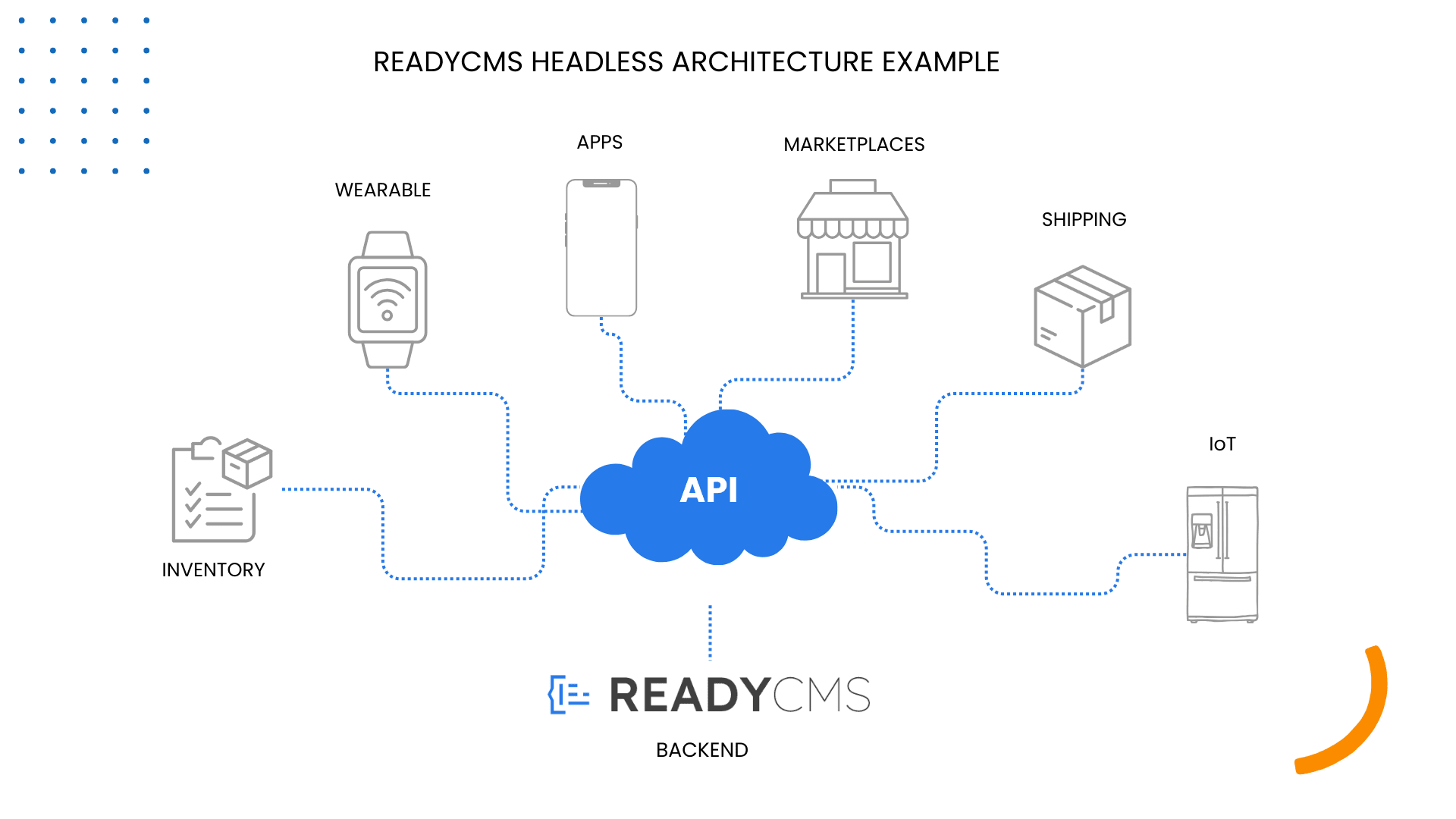
"When we started with ReadyCMS, the term 'headless' was somewhat new. From the get-go, we were captivated by its multitude of advantages. It gave us the flexibility we hadn't experienced before.” — ReadyCMS team
While typical headless CMS platforms often cater to a developer-centric audience with their complexity, ReadyCMS breaks the mold.
"We understand that a powerful CMS should not only be robust but also accessible. That’s why ReadyCMS is designed with a user-friendly approach, catering to all teams. Whether you’re a developer, a content creator, a marketer, or essentially any user administrator, ReadyCMS makes managing and delivering content seamless and straightforward, without sacrificing the power and flexibility that headless architecture offers." — ReadyCMS team
1. E-commerce platformsA business might have a website, a mobile application, and a voice assistant integration (like Alexa). A headless API can serve product data on all these fronts, ensuring uniformity.
|
2. Content management systems (CMS)Traditional CMSs tightly couple content with presentation. Modern, headless CMS platforms, on the other hand, only deal with the content. This content can be served to a website, a mobile app, or even digital billboards, all through the same API. |
3. Virtual reality & augmented realityVR and AR applications often require real-time data to enrich user experiences. A headless API can serve data to these platforms just as efficiently as it does for a traditional web page. |
4. IoT devicesThink of a smart home system where data about temperature, humidity, and security is fetched and displayed on multiple devices - your smartphone, your smartwatch, and your smart TV. A headless API makes this multi-platform display seamless. |
With businesses rapidly shifting towards digital platforms - from e-commerce stores to widespread IoT devices - the need for a flexible backend system is more prominent than ever. The headless API isn't just a tech buzzword; it's the future of digital interaction.
The headless API marks a significant shift towards a more flexible, scalable, and future-proof approach to application development. It champions the idea that while data remains crucial, the way we choose to present it can remain fluid and ever-adapting. As the digital realm becomes more diverse with myriad devices and platforms, headless APIs will undoubtedly become even more invaluable.
➡️ Interested in experiencing the power of headless CMS? Try ReadyCMS today!
Play the Audio version of this article:
Learn how ReadyCMS’ Multi-environment manager separates development, testing, staging, and production so teams can build and test changes...
Learn how to ask customers for reviews without sounding pushy, including timing tips, email examples, common mistakes, and ReadyCMS...
See how opens, clicks, open rate, and click rate reveal what works—and how ReadyCMS Mail Metrics turns every send into useful feedback.
Build a practical three-email abandoned cart sequence with recommended timings, subject line ideas, message examples, and ReadyCMS...
Learn why customers leave products in their carts, what you can improve during checkout, and how automated ReadyCMS emails can help...
ReadyCMS Assistants can simplify your website tasks, enhance SEO, and improve content quality with expert guidance.
Book a demo or talk with our team about putting these ideas to work.